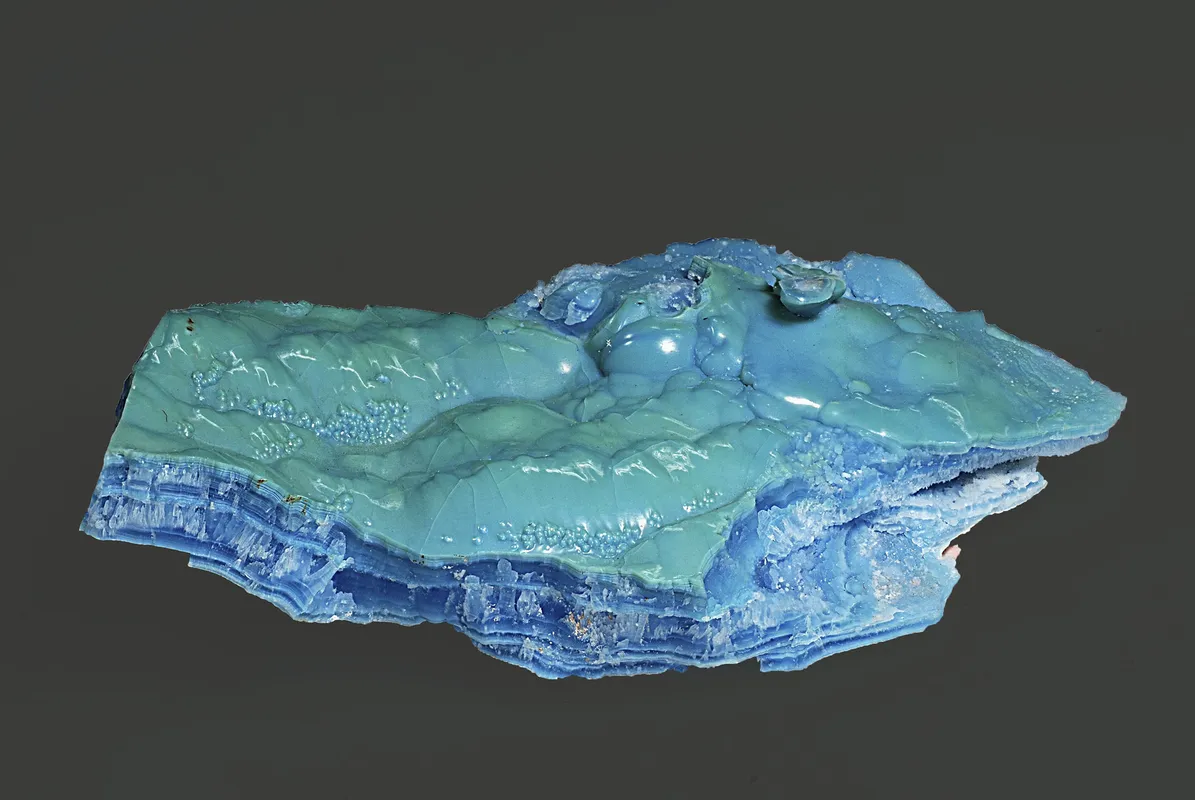
Image Credit: Frank Höhle
Specimen Title
Calcite (post-mining)
Principal Mineral
Size
Miniature; 45mm
Location in the Mine
Second oxidation zone; 28 Level; No. 1 Sublevel; East 35 Stope
Provenance
Pieters, S.
Collection
Krahn, L.; Ts-153
Entry Number
Specimen; TSNB927
Description
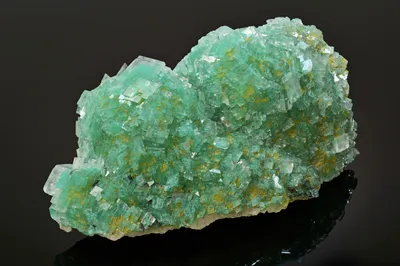
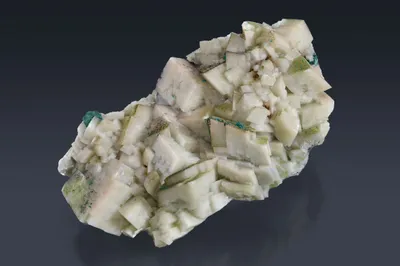
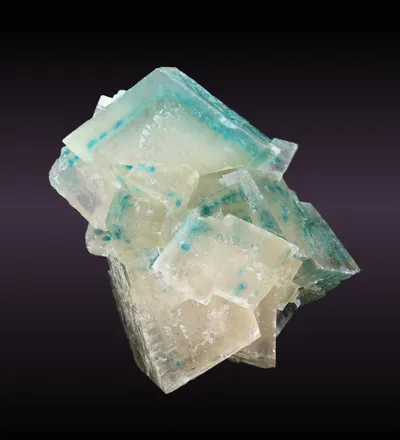
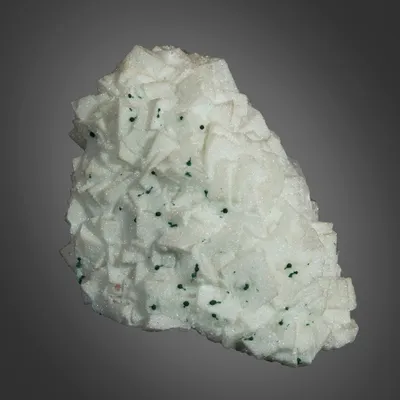
A crust of banded, blue to blue-green calcite comprising minute fibrous crystals (to circa 30 µm) aligned normal to the banding. The display face of the specimen shows a sub-botryoidal habit and a porcelain-like surface texture. Please note that this material is believed to be of post-mining origin.
This specimen is in the collection of Dr Ludger Krahn and is one of two very similar pieces purchased from Windhoek dealer Sid Pieters in May 1981 by Krahn and fellow collector Fritz Schmelzer. At the time of purchase, the specimens were believed to be Cu-bearing aragonite, formed by the flow of mine water in the underground workings, and attributed to 28 Level, No. 1 Sublevel, East 35 Stope in the second oxidation zone; they were collected in March 1981. Schmelzer's specimen was given to Dr. W. Guse at Hamburg University for study. XRD analysis confirmed that the blue carbonate is calcite (rather than aragonite); EDS confirmed the presence of trace amounts of Cu; atomic adsorption spectroscopy determined a Cu content of 0.167 wt %, and electron paramagnetic resonance spectroscopy supported the hypothesis that Cu is substituting for Ca in octahedral sites in the calcite structure. The Cu content is very low, equivalent to one atom per 60 unit cells in the calcite structure, but this is sufficient to cause the observed blue colour. This blue variety of calcite has been described in detail by Guse (1982).