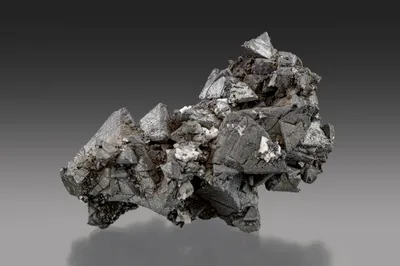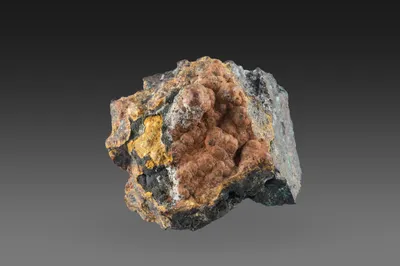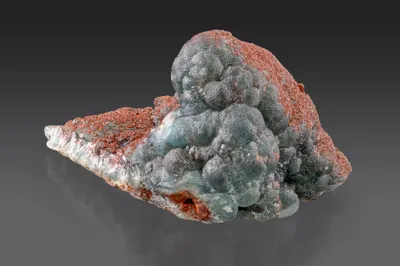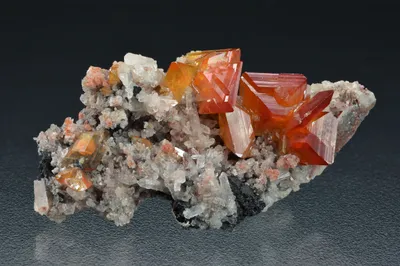
Image Credit: Bruce Cairncross
Mineral Species
Arsendescloizite
Type Locality
Yes
Composition
PbZn(AsO4)(OH)
Crystal System
Orthorhombic
Status at Tsumeb
Confirmed (type locality)
Abundance
Very rare
Distribution
Second oxidation zone
Paragenesis
Supergene
Entry Number
Species; TSNB24
Type Mineralogy
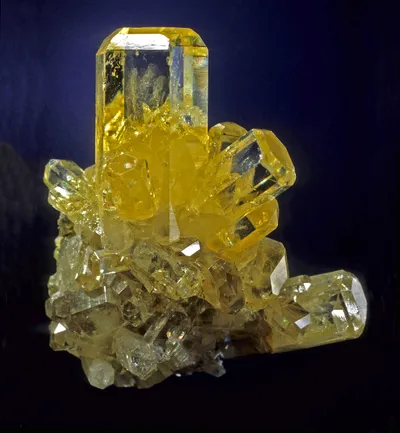
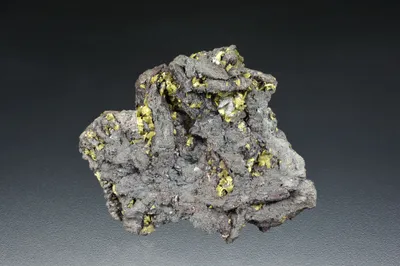
The discovery of arsendescloizite, IMA 1979-030, is credited to Dr Wolfgang Bartelke, who submitted for analysis a pale yellow mineral visually resembling adamite or tsumcorite, but yielding an X-ray pattern similar to that of descloizite. The new mineral was described by Keller and Dunn (1982a) and named for its structural similarity and compositional relationship to descloizite, of which it is the arsenate analogue.
Type material is conserved at the Institut für Mineralogie und Kristallchemie, Universität Stuttgart, Germany (catalogue number TM-79.30-B76).
General Notes
The published description of arsendescloizite (Keller and Dunn, 1982a) does not record the level in the mine from which the type material was recovered, but there is some evidence to suggest that it may have originated from 30 Level in the second oxidation zone. Most, if not all, verified examples of arsendescloizite are believed to be from the second oxidation zone.
Arsendescloizite visually resembles adamite, or even tsumcorite and may also be confused with descloizite (Keller and Bartelke 1982). Arsendescloizite is the end-member of a continuous (?) series with descloizite; however, no V, Cu, or Ca was detected in the type material.
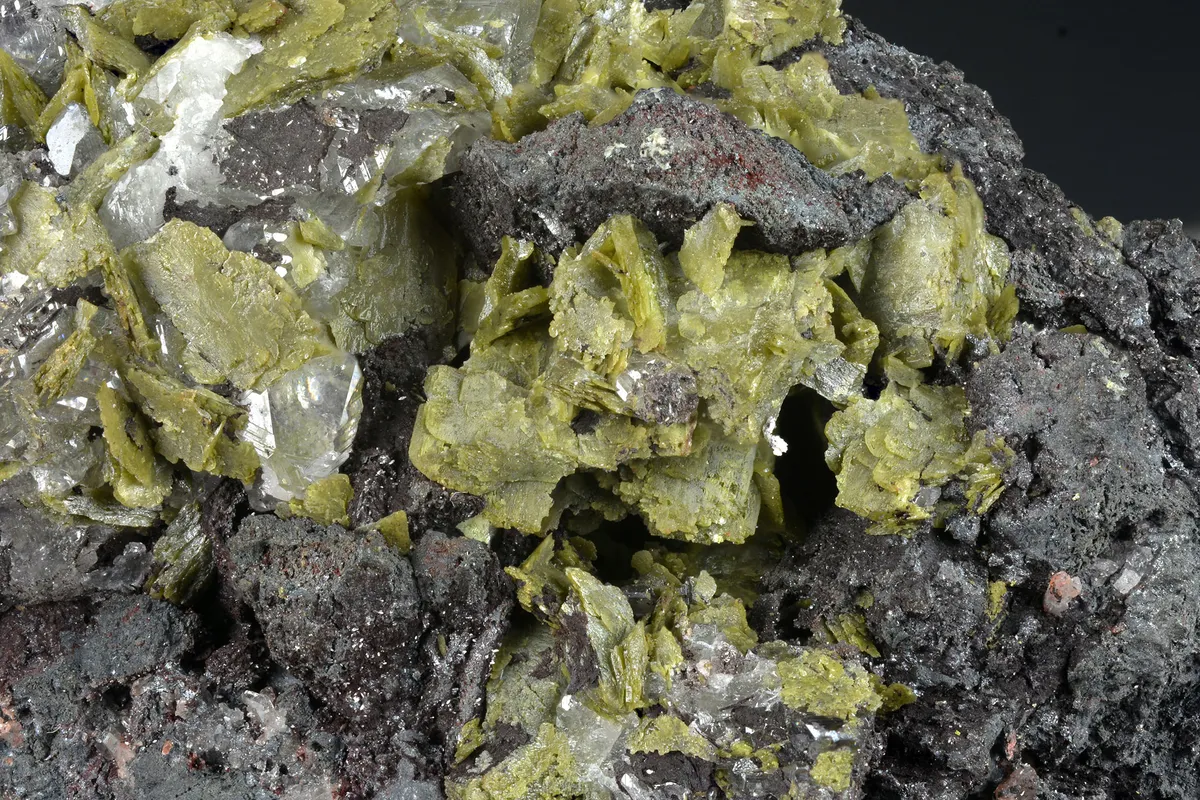
On the type specimen, bright lemon-yellow arsendescloizite occurs on a matrix of copper sulphides comprising mainly tennantite and chalcocite. It is associated with willemite, chalcocite (crystals), quartz, goethite, and corroded mimetite. Keller and Dunn (1982a) propose the following paragenesis:
chalcocite >> quartz >> mimetite >> arsendescloizite >> goethite >> willemite
Keller and Bartelke (1982) and Keller (1984) noted the occurrence of kasolite, one of only two uranium minerals known to occur at Tsumeb, associated with arsendescloizite, mimetite and willemite, a very similar paragenesis to that described for the type material.
Key (1996) described a 5 cm specimen in the collection of the late John F. Barlow (1914-2004; catalogue #5778) as
"Superb gemmy tan/colorless prismatic crystals [of arsendescloizite] to 3.5 mm in radiating groups lie on brilliant black mimetite crystals with arseniosiderite in vuggy chalcocite ore."
Gebhard (1999) illustrated a specimen of arsendescloizite on limonite which he attributed erroneously to the third oxidation zone. The specimen is now in the Feinglos Collection at Harvard University (MGMH 2022.4.7862L) where Gebhard’s original label confirms that it is in fact from the second oxidation zone.
A specimen in the collection of Museums Victoria, Australia (catalogue number M31461) shows dark-green arsendescloizite in association with wulfenite and tsumcorite. Microprobe analysis of the arsendescloizite showed it to be a calcium and copper-bearing variety, "… intermediate in the chemical series between arsendescloizite, duftite, and conichalcite" (Mills and Birch 2007).
Bowell and Mocke (2018) reported arsendescloizite in calcite veins between levels 30 and 34 in the second oxidation zone.
Associated Minerals
arseniosiderite; chalcocite; goethite; kasolite; mimetite; quartz; tennantite-(Zn); tsumcorite; willemite; wulfenite
Pseudomorphs
Arsendescloizite is reported to form pseudomorphs after mimetite (rare; Mills and Birch 2007).