Mineral Species
Kasolite
Type Locality
No
Composition
Pb(UO2)SiO4·H2O
Crystal System
Monoclinic
Status at Tsumeb
Confirmed
Abundance
Extremely rare
Distribution
First and second oxidation zones
Paragenesis
Supergene
Entry Number
Species; TSNB190
General Notes
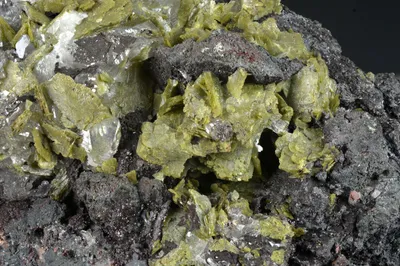
Kasolite was the first of only two uranium minerals reported from Tsumeb (the second is metazeunerite).
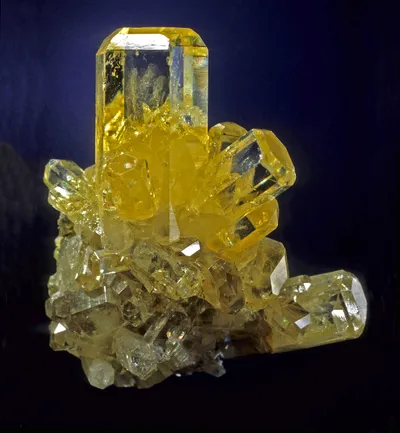
In a discussion of newly discovered minerals, implicitly from the second oxidation zone, Keller and Bartelke (1982) described prismatic crystals of kasolite to 2 mm, commonly coated by goethite and associated with arsendescloizite, mimetite and willemite. This appears to be the earliest published record of kasolite from Tsumeb.
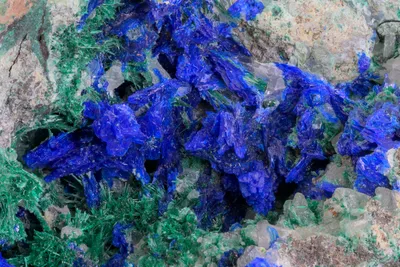
Gebhard (1999) stated that kasolite was found as tiny orange crystals on "… a single specimen of linarite collected from the outcrop" but provided no source for this report. A specimen in the Feinglos Collection at Harvard University (MGMH 2022.4.8697L) comprises a dense but cavernous matrix consisting largely of intergrown cerussite, linarite and brochantite with very sparse prismatic microcrystals (to c. 0.75 mm in length) of orange kasolite. Feinglos acquired the specimen in 2004 with a Gebhard label indicating that the specimen is from the "Green Hill" and can be traced back to German dealer Wilhelm Maucher in 1910.
A specimen from the collection of Christof Schäfer figured on Mindat (https://www.mindat.org/photo-1140279.html; accessed January 2023) shows a crystal of kasolite (EDS confirmed) associated with linarite and arsentsumebite. The owner of the specimen suggests a "Green Hill" origin on the basis of the paragenesis but, while a first oxidation zone provenance is entirely plausible, there appears to be nothing to confirm that the material came from the outcrop.
Associated Minerals
arsendescloizite; arsentsumebite; brochantite; cerussite; goethite; linarite; mimetite; willemite