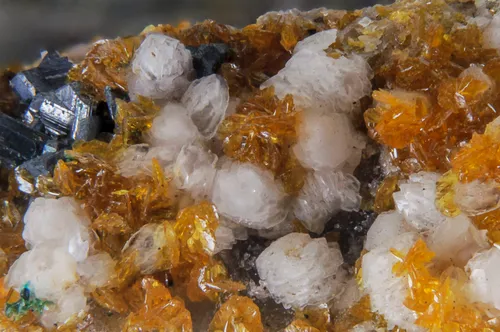
Image Credit: Malcolm Southwood
Mineral Species
Arsenbrackebuschite
Type Locality
Yes
Composition
Pb2Fe3+(AsO4)2(OH)
Crystal System
Monoclinic
Status at Tsumeb
Confirmed (type locality)
Abundance
Very rare
Distribution
Second oxidation zone
Paragenesis
Supergene
Entry Number
Species; TSNB23
Type Mineralogy
Arsenbrackebuschite was first encountered at Tsumeb by TCL mineralogist Bruno Geier in about 1966 (Abraham et al. 1978), on 30 Level in the second oxidation zone (Daltry 1992). A detailed description was published by Hofmeister and Tillmanns (1976) but the composition of the mineral was subsequently revised (Hofmeister and Tillmanns 1978a) and a structure solution provided (Hofmeister and Tillmanns 1978b). IMA approval for the new species was granted in 1977 (IMA 1977-014) and a full description of arsenbrackebuschite based on dual type localities of Tsumeb and Grübe Clara, in Germany was published by Abraham et al. (1978). The mineral was named for its chemical relationship to brackebuschite.
The Clara Mine co-type material is conserved at the Institut für Mineralogie und Kristallchemie, Universität Stuttgart, Germany (catalogue number CL1,14).
General Notes
The Tsumeb co-type specimen is from 30 Level, in the second oxidation zone (Abraham et al. 1978).
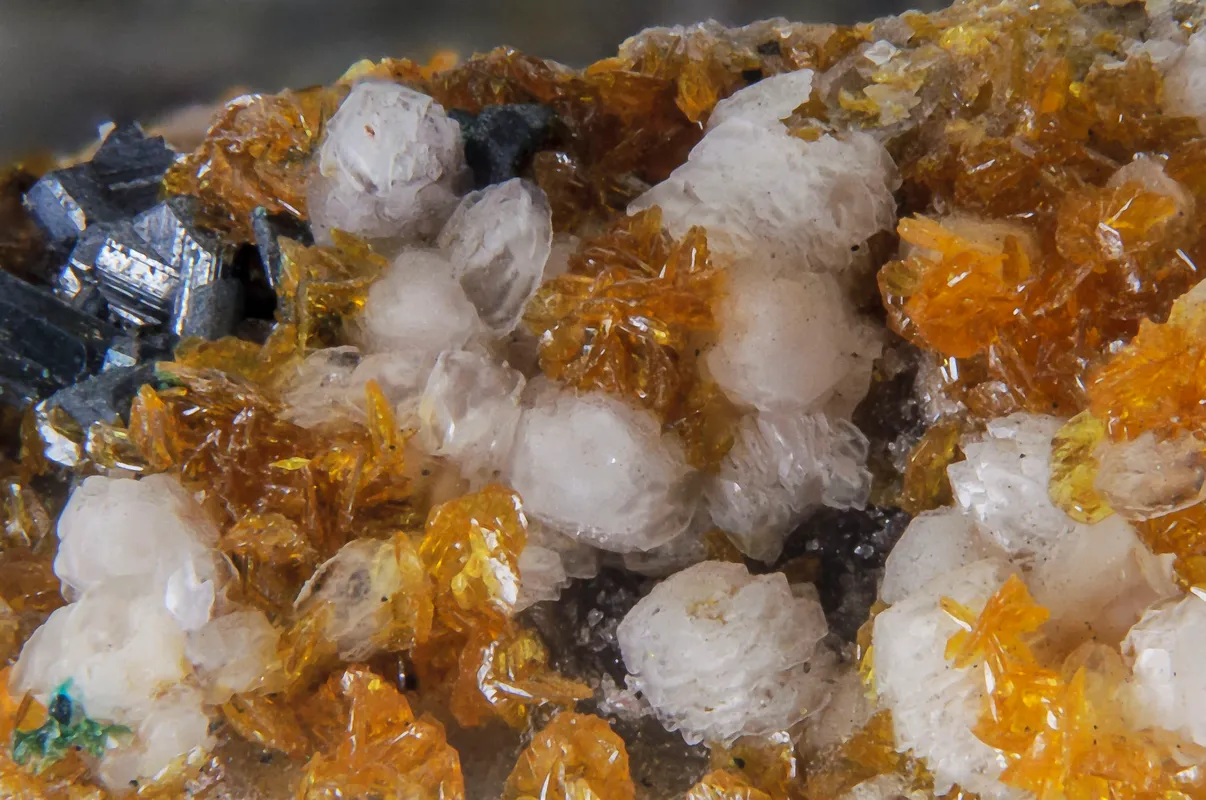
Arsenbrackebuschite was originally described as flat laths or platelets (to 0.5 mm), typically twinned and honey-yellow in colour, on fissures in dolomite breccia, associated with zinc-bearing dolomite (Abraham et al. 1978). The crystals resemble those of tsumcorite, with which arsenbrackebuschite is readily confused.
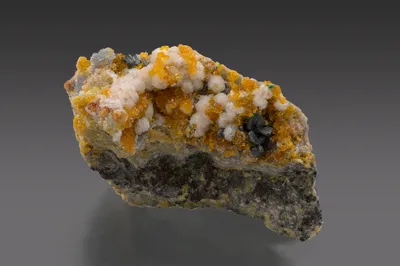
A specimen in the Southwood Collection (MS2009.040) comprises loose aggregates of tabular sub-mm crystals of rich lemon-yellow arsenbrackebuschite associated with rosettiform groups of white calcite and well-formed crystals of metallic, dark grey chalcocite.
Bowell and Mocke (2018) described arsenbrackebuschite as "… widespread in the second oxidation zone", having concluded that some specimens formerly identified as tsumcorite are, in fact, arsenbrackebuschite. They also reported a distinctive "earthy" variety of arsenbrackebuschite containing 5.4 wt % Sb2O5, in material that they believed to originate from 34 Level.
Associated Minerals
calcite; chalcocite; dolomite