Image Credit: John Schneider
Mineral Species
Andyrobertsite
Type Locality
Yes
Composition
KCdCu5(AsO4)4[As(OH)2O2] ∙2H2O1
Crystal System
Monoclinic
Status at Tsumeb
Confirmed (type locality)
Abundance
Extremely rare
Distribution
First and third oxidation zones
Paragenesis
Supergene
Entry Number
Species; TSNB11
Type Mineralogy
The type specimen for andyrobertsite (and calcioandyrobertsite) is believed to have been mined at Tsumeb in the early 1950s (Cooper et al. 1999), indicating a high probability that it is from the first oxidation zone. It originally belonged to Richard Baughart, a mining engineer working at Tsumeb but changed hands several times before being purchased by Bill Pinch at the 1996 Denver show, labelled as zinc-deficient keyite.
Analysis demonstrated the presence of two new minerals, andyrobertsite (IMA 1997-022) and calcioandyrobertsite (IMA 1997-023). The crystal structure (of both minerals) was refined and solved by Cooper and Hawthorne (2000). Andyroberstsite was named to honour Andrew C. Roberts (b. 1950), mineralogist with the Geological Survey of Canada (Cooper et al. 1999).
Type material is conserved at the Royal Ontario Museum (catalogue numbers M47022 and M47110) and at the Smithsonian Institution (catalogue number NMNH 171487).
General Notes
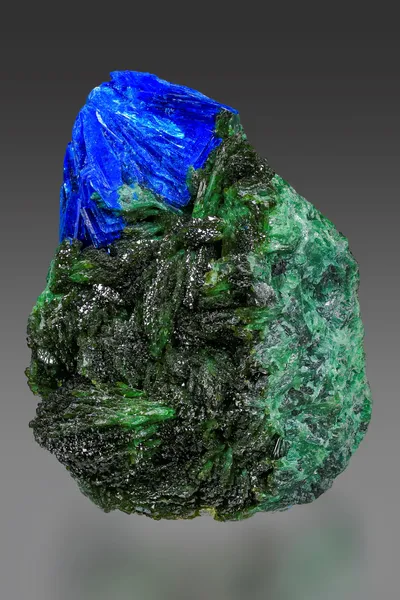
The type assemblage comprises andyrobertsite (with calcioandyrobertsite) on tennantite, with zincolivenite, and olivenite (Cooper et al. 1999).
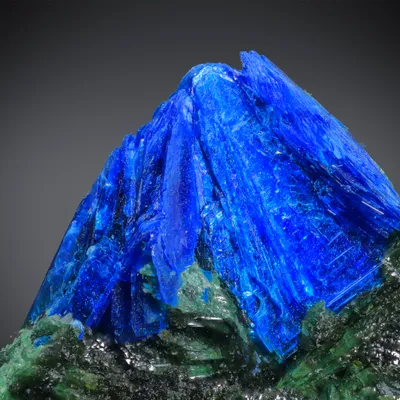
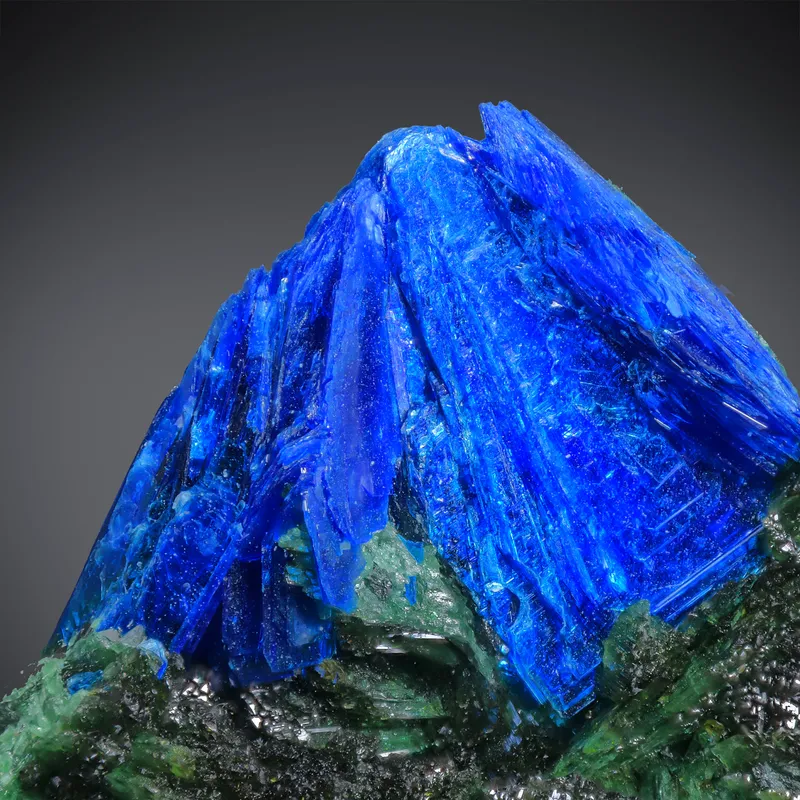
On the type specimen andyrobertsite and calcioandyrobertsite occur as intimate lamellar intergrowths that are crystallographically continuous and not visually distinguishable. They form platy crystals, electric-blue in colour, with a vitreous lustre; the crystals are brittle with a good cleavage on (001) and a conchoidal fracture.
Associated Minerals
bradaczekite (?); calcioandyrobertsite; olivenite; tennantite-(Zn); zincolivenite