Mineral Species
Calvertite
Type Locality
Yes
Composition
Cu5Ge0.5S4
Crystal System
Cubic
Status at Tsumeb
Confirmed (type locality)
Abundance
Extremely rare
Distribution
Sulphide ores
Paragenesis
Hypogene
Entry Number
Species; TSNB68
Type Mineralogy
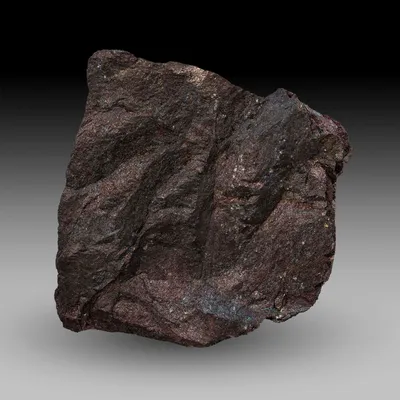
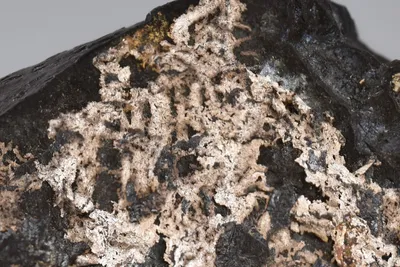
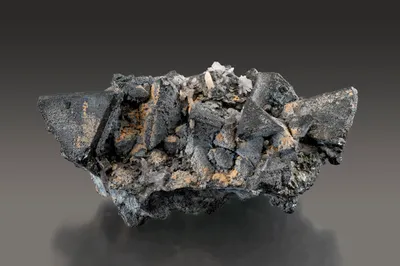
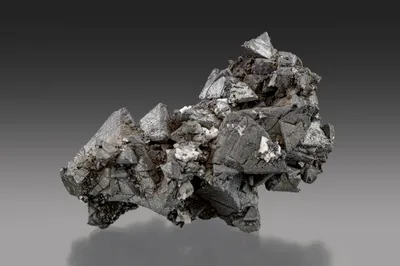
The type specimen for calvertite is believed to have been collected in about 1960, but from an unknown location in the mine. It was acquired by Mark Feinglos from Forrest and Barbara Cureton in June 1987 labelled as "Fleischerite with Renierite, Germanite etc. ". Feinglos realised immediately that the off-white secondary mineral was not fleischerite and submitted it for analysis, leading to the description of the new mineral gallobeudantite (Jambor et al. 1996). During this investigation it was found that a major component of the sulphide matrix was also a new mineral. IMA 2006-030 was described by Jambor et al. (2007) and named for Lauriston (Larry) Calvert (1924-1993) of the National Research Council, Ottawa, Canada.
Co-type polished sections of calvertite are conserved at the Canadian Museum of Nature, Ottawa (catalogue number CMNMC 85731) and at the Natural History Museum, London (catalogue number BM.2004,078). A large portion of the original specimen remains in the Feinglos Collection, now at Harvard University (MGMH 2022.4.5980T).
General Notes
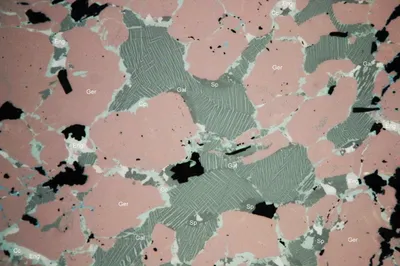
The calvertite type specimen consists of partly oxidising copper and germanium sulphide, comprising renierite, tennantite, gallite, and chalcocite with calvertite forming banded intergrowths with renierite (Jambor et al. 2007). A shallow vug on the surface of the specimen contains gallobeudantite, hidalgoite, hematite and stolzite as well as un-named Ga analogues of segnitite, corkite, kintoreite and arsenocrandallite (Jambor et al. 1996).
According to Jambor et al. (2007):
"Calvertite is macroscopically black and has a metallic luster, a black streak, brittle tenacity, an irregular to conchoidal fracture, and no cleavage, parting, or fluorescence. The Mohs hardness is 4 to 5…. The mineral is opaque, and in reflected light is pale bluish grey and without internal reflections, pleochroism or bireflectance."
Associated Minerals
chalcocite; digenite; djurleite; gallite; gallobeudantite; goethite; hematite; otjisumeite; quartz; renierite; silver; stolzite; tennantite-(Zn)