Mineral Species
Zincostottite
Type Locality
Yes
Composition
ZnGe(OH)6
Crystal System
Tetragonal
Status at Tsumeb
Confirmed (type locality)
Abundance
Extremely rare
Distribution
Undetermined
Paragenesis
Supergene
Entry Number
Species; TSNB493
Type Mineralogy
Zincostottite, IMA 2024-024, was discovered by Joy Désor on a specimen of germanium-rich ore from the collection of the late Karl Seifert, a German mining engineer who worked at Tsumeb in the 1960s. It is the zinc analogue of stottite and is named for the compositional relationship (Kampf et al. 2024c). Type material is conserved in the collections of the Natural History Museum of Los Angeles County, catalogue numbers 76278 (holotype) and 76279 (cotype).
General Notes
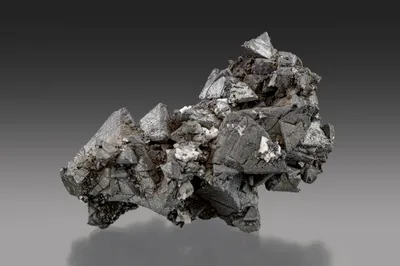
Zincostottite occurs as etched remnants (to circa 1 mm) of tabular or equant crystals on fracture surfaces in germanium rich sulphide ore, which probably originated from the germanium ore horizon on 30 Level in the second oxidation zone (Kampf et al. 2025). The crystals are transparent, straw-yellow in colour and brittle with an irregular stepped fracture. Cleavage is good on {100} and poor on {001}. The principal matrix constituents for the type specimens are bornite, chalcocite, germanite and tennantite-(Zn). Associated secondary minerals are malachite, quartz and siderite (Kampf et al. 2025); also segnitite, siderite and stottite (Joy Désor, pers. comm. to M. Southwood, March 2025).
Associated Minerals
bornite; chalcocite; malachite; quartz; segnitite; siderite; stottite; tennantite-(Zn)