Mineral Species
Jeanbandyite
Type Locality
No
Composition
Fe3+Sn4+(OH)5O
Crystal System
Cubic
Status at Tsumeb
Believed valid
Abundance
Extremely rare
Distribution
Second (?) oxidation zone
Paragenesis
Supergene
Entry Number
Species; TSNB186
General Notes
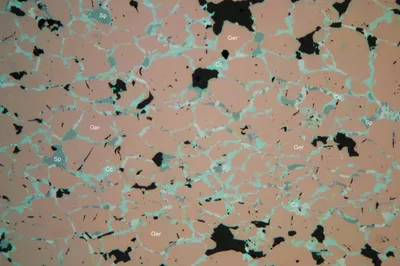
In a study of sulphide minerals, mainly from between 29 and 34 levels (i.e., second oxidation zone) Geier and Otteman (1970a) reported a number of potentially new minerals, one of which was a sulphide of copper and tin, to which they assigned a working name of "Mineral Lu". Subsequent study (Geier and Otteman 1970b) showed the presence of an oxide mineral occupying fractures in Mineral Lu, for which microprobe analysis gave a composition corresponding to an ideal formula of FeSn(OH)6, but with a little manganese and germanium (partly replacing iron and tin respectively). Unfortunately, they had insufficient material for XRD analysis, but assigned a working name of "Mineral D" to what appeared to be a tin analogue of stottite.
Jeanbandyite (IMA 1980-043), the tin analogue of stottite, was described from a Bolivian type locality some ten years later (Kampf 1982). Kampf noted that naturally occurring FeSn(OH)6 had already been reported from Tsumeb by Geier and Otteman (1970b) but that neither the symmetry nor the oxidation state of the iron had been determined.
In 2020 the occurrence of jeanbandyite at Tsumeb was reported by Joy Désor on the basis of EDS and Raman analysis ( Joy Désor - New minerals for the Tsumeb mine, Namibia (mindat.org); accessed October 2022). The jeanbandyite occurs as irregular brown crystals (to 0.35 mm) on germanite ore with sparse grains of dzhalindite on the jeanbandyite surface.
Associated Minerals
chalcocite; dzhalindite; germanite