Image Credit: John Schneider
Mineral Species
Ekatite
Type Locality
Yes
Composition
(Fe3+,Fe2+,Zn)12(OH)6(AsO3)6[AsO3,SiO3(OH)]2
Crystal System
Hexagonal
Status at Tsumeb
Confirmed (type locality)
Abundance
Extremely rare
Distribution
Second (?) oxidation zone
Paragenesis
Supergene
Entry Number
Species; TSNB116
Type Mineralogy
Ekatite was discovered in 1998 on material collected some five years earlier. The discovery is attributed to Michael Greiser (a German collector) who presented the unidentified mineral for analysis. Ekatite, IMA1998-024, was described by Keller (2001) and named for Namibian mining engineer Dieter Ekat (1935-1996). An earlier paper on the structure of ekatite was published by Keller et al. (1999). Type material is conserved at the Institut für Mineralogie und Kristallchemie, Universität Stuttgart, Germany (catalogue number NM 20 and TM-98.24-Gro19 [Paul Keller Collection]).
General Notes
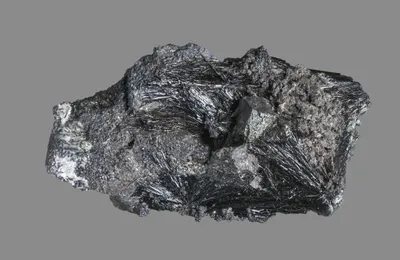
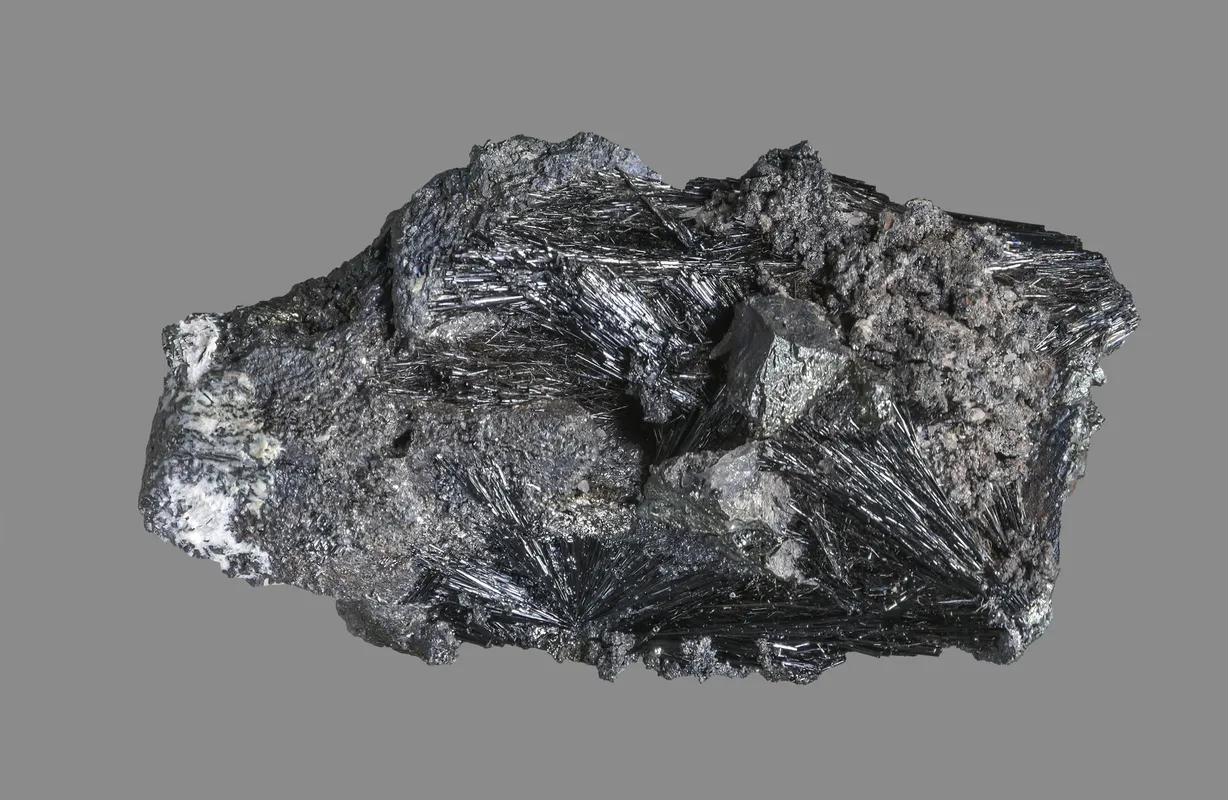
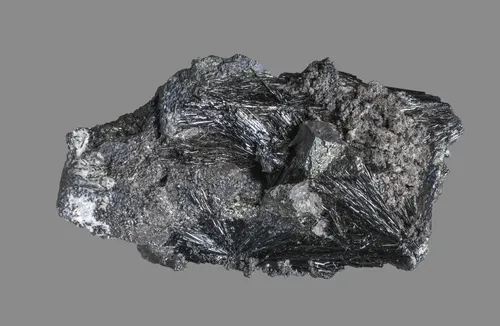
Ekatite was found only once at Tsumeb. All known specimens (including the type material) can be traced back to Windhoek dealer Herbert Nägle whose unpublished records indicate that he purchased them from Tsumeb baker and part-time mineral broker Anton ("Toni") Pietsch in 1993 (Ernst Schnaitmann, pers. comm. to M. Southwood, 2017; Southwood 2018). Both Pietsch and Nägle believed that the material was from the deeper levels of the mine and probably from the second oxidation zone. Arguably the best specimen from this discovery is in the Pinch Collection, now housed at Harvard University (MGMH 2020.7.670). It comprises several sprays of radiating ekatite needles on a predominantly chalcocite matrix with a little quartz.
Ekatite is one of the rarer arsenite minerals discovered from Tsumeb. It occurs on a matrix of chalcocite and quartz, as small radiating sprays of striated brownish-black needles. Keller (2001) observed that the occurrence of other arsenite minerals in the "deeper levels" of the mine is consistent with a similar origin for ekatite, but the precise level of the discovery was not recorded. While the specimens are generally believed to be from the second oxidation zone, a third oxidation zone origin is also possible.
Associated Minerals
chalcocite; quartz