Trending...
01 October 2026
Wilhelm Klein (1889-1939) was a senior manager at Tsumeb between 1916 and 1939. His mineral collection was purchased for Harvard University in 1954 by Professor Clifford Frondel and Klein's handwritten catalogue was donated to MGMH by his descendants in 2023. The Klein Collection is a cornerstone of Harvard's Tsumeb specimen suite.
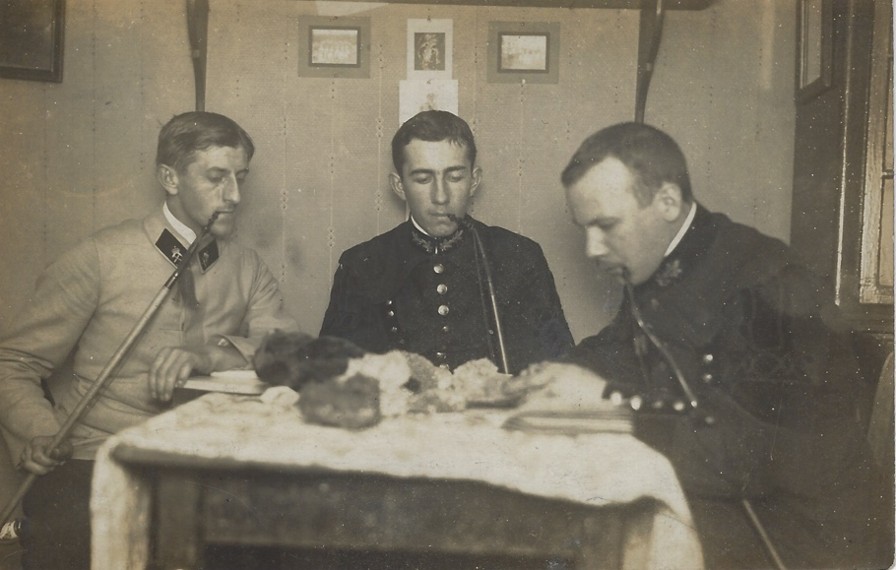
Wilhelm Klein (centre), with classmates, examining mineral specimens during his time as a mining student at Bergschule, circa 1912. Image courtesy of the Wilhelm Klein Tsumeb Archive.
Wilhelm Klein was born on 29 November 1889 in the Siegerland region of Germany. He graduated first class in mining in 1913 from the Bergschule in Siegen, Germany, which allowed him to apply for a relatively senior mining role in Deutsch Südwestafrika (now Namibia).
Klein arrived at Tsumeb in 1916 and, like several senior managers of the time, started to build a collection of minerals. Unlike his peers, however, Klein took the trouble to record the level in the mine at which he found each of his specimens. In August 1938 he delivered a lecture entitled "Die Mineralien der Tsumeber Erzlagerstätte" [The Minerals of the Tsumeb Ore Deposit] to a meeting of The Association of German Occupational Groups in South West Africa. Fortuitously, a transcript of his lecture was published a month later in a Windhoek newspaper (Klein 1938) and this article, together with Klein's collection catalogue, is the source of much of our knowledge on the distribution of minerals in Tsumeb's first oxidation zone. Sadly, Klein died in 1939 from complications following surgery for appendicitis.
Please follow this link to see some of Wilhelm Klein's Tsumeb specimens.
We are indebted to Klein's grandchildren Michael Lange and Barbara Kloos for much of the information on which these notes are based. A more expansive account of Klein's contribution to Tsumeb mineralogy has been published by Southwood et al. (2019, 2021).
22 August 2026
We are excited to add this fine specimen from Tsumeb’s first oxidation zone, courtesy of its owner Paul Melville.
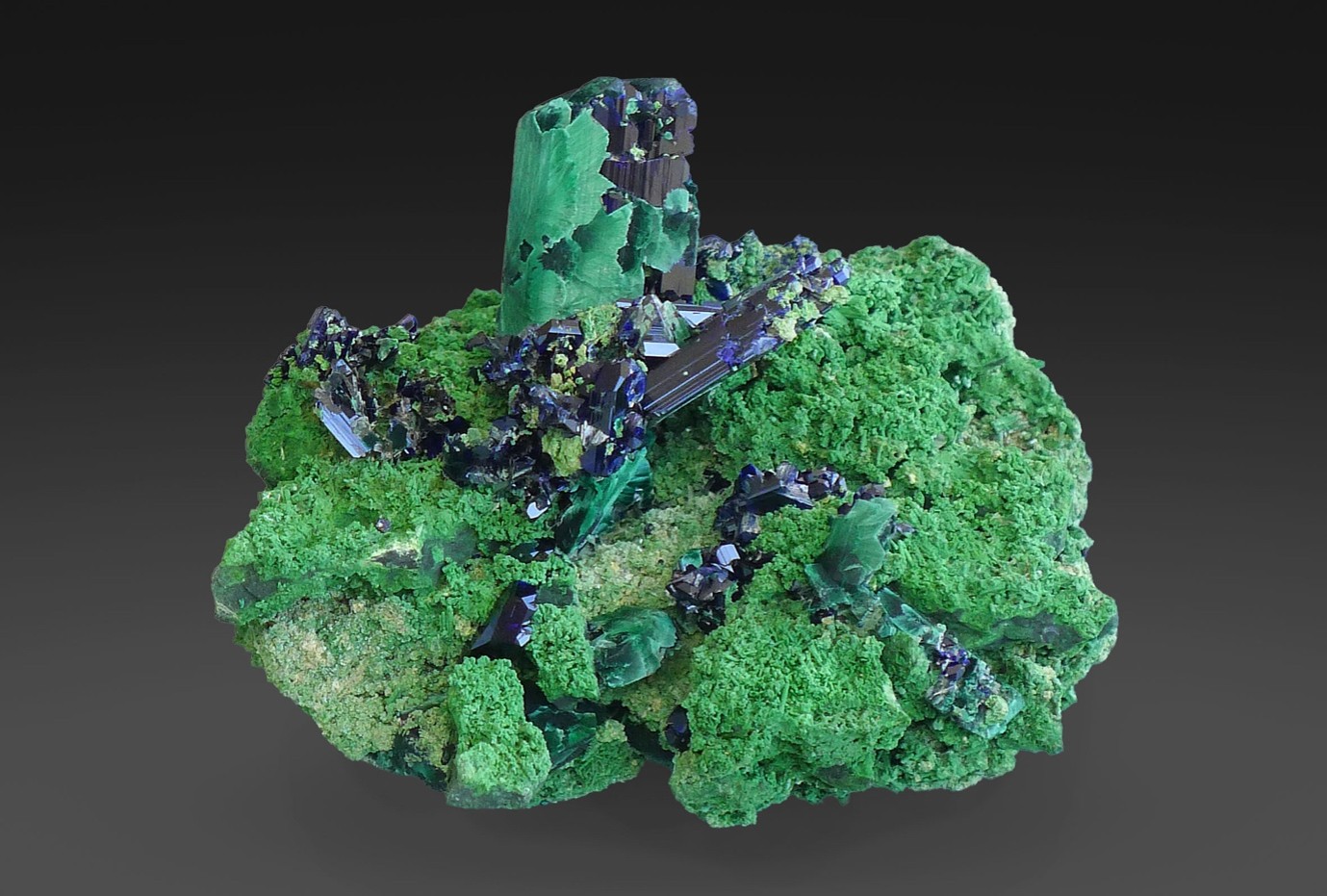
Azurite (w. malachite after azurite and bayldonite (?) after mimetite; 75mm. Paul Melville Collection and photo.
Bright, lustrous crystals of azurite, replaced to varying degrees by malachite, on a matrix of bayldonite (?) and / or arsentsumebite (?), much of which is pseudomorphous after mimetite. The specimen measures 75 mm across.
The paragenesis is typical – diagnostic even – of the upper part of the first oxidation zone and this particular example is accompanied by an interesting and unusual provenance. Paul acquired it from Dan Wenrich who was dispersing a number of specimens from the collection of German industrialist and politician Otto Gruson (1863-1929). Gruson’s label (in German), which is pasted into the specimen’s card tray, appears to provide an insight into the mode of occurrence. It translates as: “Occurrence: In the metasomatic copper-ore deposit, in cavities in lumps and nests of copper ore which occur together with sand in the limestone.” A label on the underside of the box tells us that Gruson acquired the specimen from dealer Arthur Kusche (of Munich) in August 1913, for a price of 18 Marks.
In 1913, underground mining at Tsumeb was only down to 6 Level (approximately 160 m below the surface), so the provenance also dates the specimen unequivocally to the upper levels. Please see TSNB998 for further images and details.