Mineral Species
Cornwallite
Type Locality
No
Composition
Cu5(AsO4)2(OH)4
Crystal System
Monoclinic
Status at Tsumeb
Believed valid
Abundance
Extremely rare
Distribution
First oxidation zone
Paragenesis
Supergene
Entry Number
Species; TSNB95
General Notes
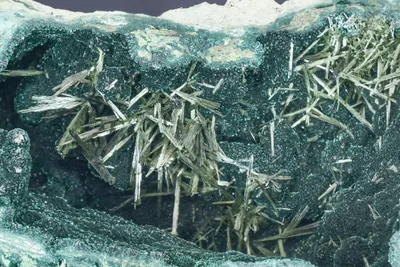
Maucher (1908a,b) provisionally identified "erinite" as a grey-green crust on malachite, but was unable to isolate a sample of sufficient purity for analytical confirmation. Unfortunately, this record is ambiguous because "erinite" is a pseudonym of both chalcophyllite (Beudant 1832, Des Cloizeaux 1845; see Palache et al. 1951) and cornwallite (Haidinger 1828; see Palache et al. 1951).
Bartelke (1976) cautiously interpreted Maucher’s (1908a) "erinite" as cornwallite, which seems reasonable, given that Maucher’s description (habit and colour) appears more consistent with cornwallite than with chalcophyllite. (It is noted, however, that Pinch and Wilson (1977) took the opposite view, listing "Chalcophyllite ("erinite")" as occurring at Tsumeb on the basis of Maucher’s (1908a) commentary.)
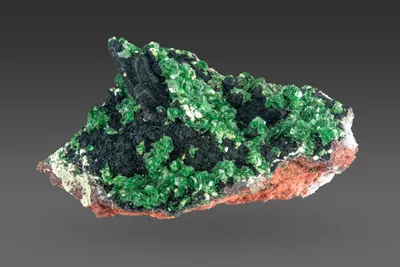
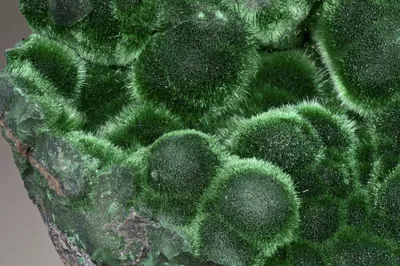
Gebhard (1999) reported that the only known specimen of cornwallite (with malachite and bayldonite, on quartz), is held at the Hamburg Museum, in Germany. A portion of this specimen, supplied by Gebhard, is now in the Feinglos Collection at Harvard University (MGMH 2022.4.8098). The cornwallite occurs as sparse green microcrystalline spherules (to 0.5 mm) on milky-white quartz which is highlighted by dustings of an unidentified green arsenate – possibly also cornwallite (?) or possibly bayldonite as suggested by Gebhard.
A further specimen of cornwallite (XRD-verified) in the collection of Gerhard Brandstetter is figured on Mindat (https://www.mindat.org/photo-578840.html; accessed June 2020). On this specimen the cornwallite occurs as microcrystalline aggregates lining a vug in iron-stained quartz. Other vugs in the matrix contain olivenite crystals.
Associated Minerals
bayldonite; malachite; olivenite; quartz