Mineral Species
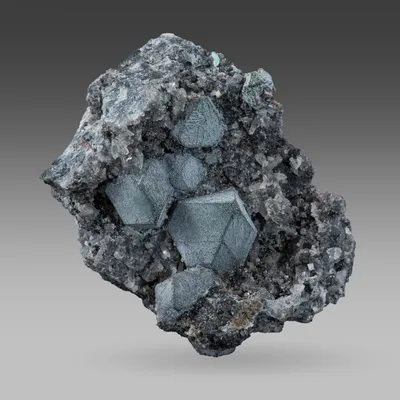
Carrolite
Type Locality
No
Composition
CuCo2S4
Crystal System
Cubic
Status at Tsumeb
Believed valid
Abundance
Very rare
Distribution
Second oxidation zone; sulphide ores
Paragenesis
Hypogene
Entry Number
Species; TSNB70
General Notes
Tiny crystals of Ni-rich carrollite were first observed at Tsumeb by Geier (1973-74), who noted that they are barely visible to the naked eye and associated with equally rare crystals of the cobalt sulphide linnaeite (Co3S4). These minerals are generally visible only by reflected light microscopy.
Pinch and Wilson (1977) described "… tiny, light steel-gray crystals [of carrollite] visible under the microscope".
Lombaard et al. (1986) considered carrollite to be extremely rare.
Hughes (1987) described Ni-rich carrollite intergrown with and replaced by galena, and as skeletal and subhedral grains in bornite. His EMPA analysis of carrollite from West 80 on 30 Level yielded the following average composition (based on four analyses):
Co 26.2 wt %; Ni 12.4 wt %; Cu 21.1 wt %; Fe 0.9 wt %; S 40.2 wt % (total wt % = 100.8).
Gebhard (1999) noted the occurrence of carrollite as microscopic blebs in massive sulphide ore.
Associated Minerals
bornite; galena; linnaeite (?); millerite
Pseudomorphs
Hughes (1987) described supergene millerite replacing Ni-rich carrollite.