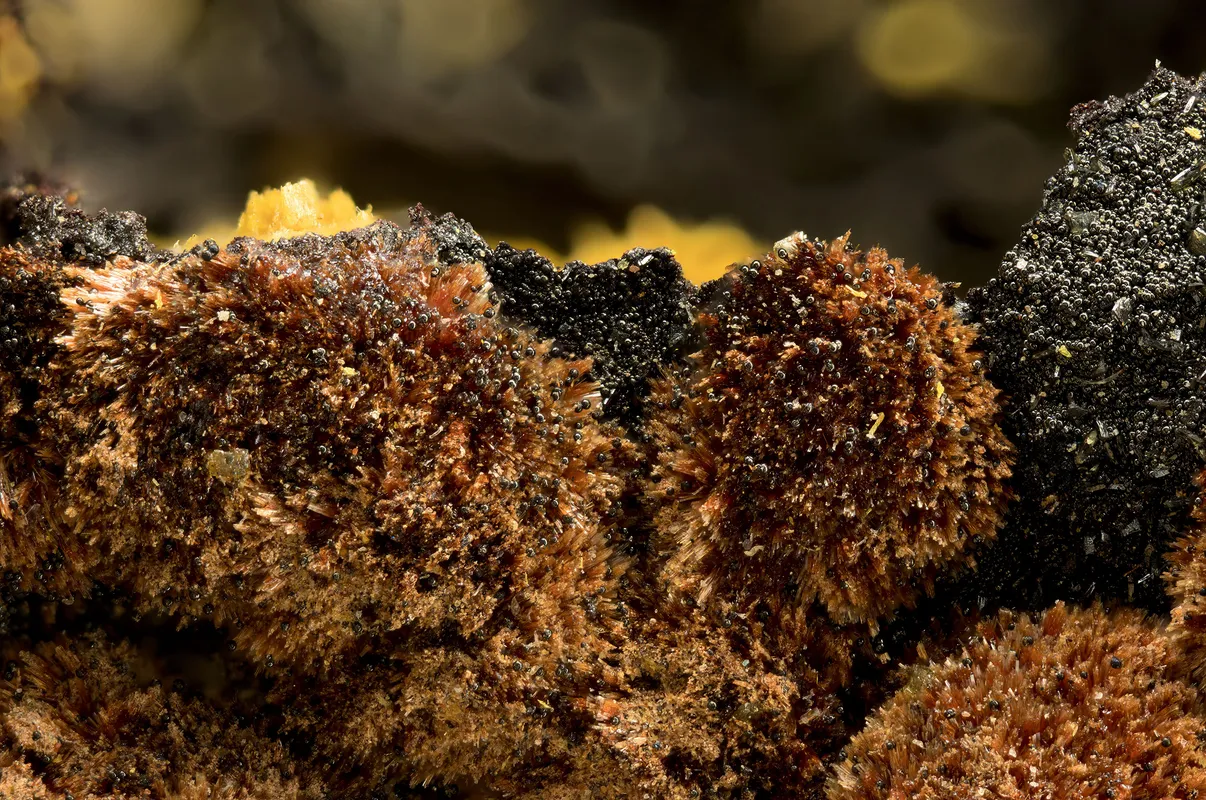
Image Credit: Eugene Cisneros
Mineral Species
Jamesite
Type Locality
Yes
Composition
Pb2ZnFe3+2(Fe3+,Zn)(AsO4)4(OH)8[(OH),O]2
Crystal System
Triclinic
Status at Tsumeb
Confirmed (type locality)
Abundance
Extremely rare
Distribution
Second oxidation zone
Paragenesis
Supergene
Entry Number
Species; TSNB183
Type Mineralogy
The discovery of jamesite is credited to German geologist/mineralogist and mineral collector Wolfgang Bartelke, who worked at Tsumeb in the mid-1970s (Gebhard 1999). The location in the mine from which the type specimen was recovered was not included in the original description of jamesite, but it is believed to originate from the second oxidation zone and is probably from 30 Level (see below). Jamesite, IMA 1978-079, was described by Keller et al. (1981b). The mineral is named for Christopher James, a mining engineer and leader of an expedition in 1900 to evaluate copper deposits at Tsumeb and in the Otavi Valley. Cooper and Hawthorne (1999a) refined the structure of jamesite and published a modified formula. Type material is conserved at the Institut für Mineralogie und Kristallchemie, Universität Stuttgart, Germany (catalogue number TM-78.79-8910.20) and at the Smithsonian Institution in Washington D.C.
General Notes
While the location from which the type material was recovered was not recorded formally, there is circumstantial evidence that it originated from East 49 on 30 Level, the same source as the type material for tsumcorite. Part of the evidence is as follows:
- A specimen of jamesite in the Feinglos Collection at Harvard University (MGMH 2022.4.6455T) is accompanied by a handwritten label from Paul Keller (principal author of the jamesite description; Keller et al. 1981b) which reads, inter alia: "Tsumeb 30 Level E49 … Jamesite (co-type)."
- Tsumcorite was described by Geier et al. (1971) from material collected in 1964 from 30 Level E49. A second specimen in the Feinglos Collection (MGMH 2022.4.8121T) is one of several pieces from Geier’s private collection that appear to have been conserved as tsumcorite type material. Feinglos acquired his specimen of tsumcorite type material from Dr Georg Gebhard, who’s label reads: "Tsumcorite, Jamesite, Duftite, Carminite. 30 Level 49 East. Tsumeb 1964. Part of type specimen for tsumcorite and jamesite, coll. Bruno Geier."
An examination of these two specimens reveals very similar parageneses and very similar habits of the principal associated minerals – dolomite, duftite, goethite and tsumcorite. It is noted, however, that this list of associated minerals differs from the paragenesis described in the original description of tsumcorite (Geier et al. 1971). Nevertheless, it seems probable that Walter Bartelke’s discovery of jamesite and its subsequent description by Keller et al. (1981b) were based on a re-examination of material that had also been mined from 30 Level E49 in 1964.
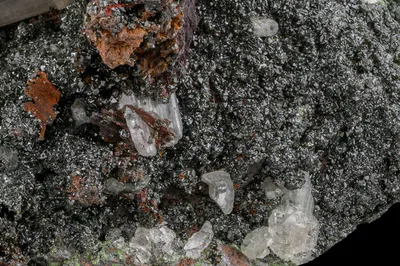
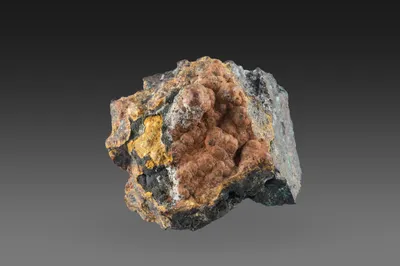
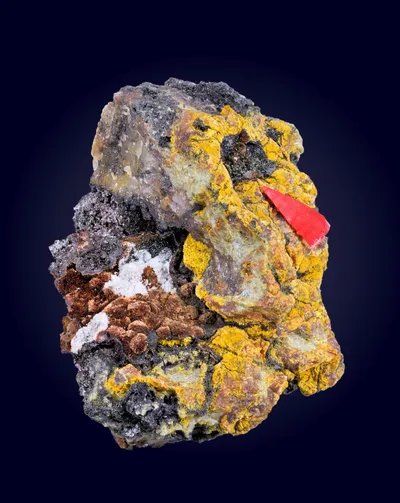
Jamesite occurs as reddish-brown translucent to transparent crystals and radiating masses (Keller et al. 1981b; Keller and Bartelke 1982). Euhedral crystals are acicular or bladed on {010} and elongated parallel to [100] with a maximum length of 0.5 mm. Radiating sprays of jamesite to (1 mm diameter) commonly present a pustular appearance.
Masses of jamesite are easily confused with goethite (which is very much more common), and euhedral crystals could be mistaken for carminite or ludlockite (although these two minerals have very different associations (Keller and Bartelke 1982). Jamesite is an extremely rare mineral but is easily overlooked.
Keller and Bartelke (1982) proposed the following paragenesis, which is a variant of sequence I/1 (of Keller 1977a):
I/1: duftite (i) >> tsumcorite >> goethite >> jamesite >> duftite (ii) >> dolomite
This sequence is believed to have formed under near-neutral pH conditions (Keller 1977a).
Associated Minerals
duftite; dolomite; goethite; tsumcorite