Mineral Species
Anorthoroselite
Type Locality
No
Composition
Ca2Co(AsO4)2∙2H2O
Crystal System
Triclinic
Status at Tsumeb
Believed valid
Abundance
Extremely rare
Distribution
Second oxidation zone
Paragenesis
Supergene
Entry Number
Species; TSNB17
General Notes
Anorthoroselite, the triclinic dimorph of roselite, was formerly known as roselite-β, roselite-beta or beta roselite and appears under these names in Tsumeb-related literature from the 1980s through 2022, when the name change (to anorthoroselite) was approved by the IMA (Miyawaki et al. 2022).
The first published report of anorthoroselite at Tsumeb was by Schmetzer and Tremmel (1982) who describe a specimen from 30 Level in the second oxidation zone which had been collected in 1980. The matrix consists of fine grained dolomite with muscovite and chlorite encrusted with crystals of colourless to yellow calcite. Polycrystalline aggregates of pinkish-red to reddish-brown beta-roselite [= anorthoroselite] rest on the calcite and consist of intergrown tabular crystals (to c. 1 mm). The anorthoroselite was identified by EDS and XRD.
Keller and Bartelke (1982; citing a pers. comm. from K. Schmetzer) provided a short summary of this discovery (in English); they reported rose to reddish-brown aggregates of roselite-β [= anorthoroselite] in association with calcite, a simple description which Keller (1984) repeated without further elaboration.
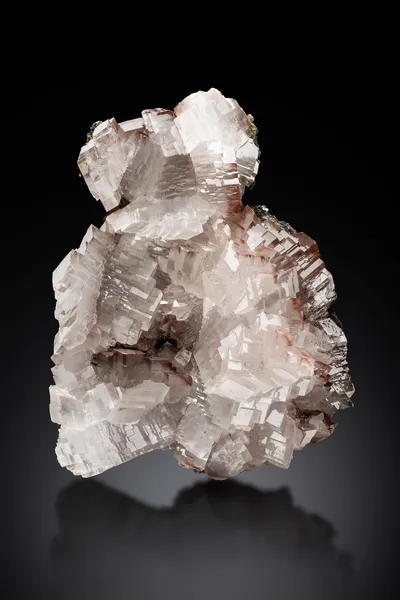
Gebhard (1999) stated that roselite-β [= anorthoroselite] was "… found once as pink crystal clusters up to 4 cm near the 30 level".
Associated Minerals
calcite; clinochlore; dolomite; muscovite; talmessite