Mineral Species
Fluorite
Type Locality
No
Composition
CaF2
Crystal System
Cubic
Status at Tsumeb
Confirmed
Abundance
Very rare
Distribution
Third oxidation zone; sulphide ores
Paragenesis
Hypogene
Entry Number
Species; TSNB133
General Notes
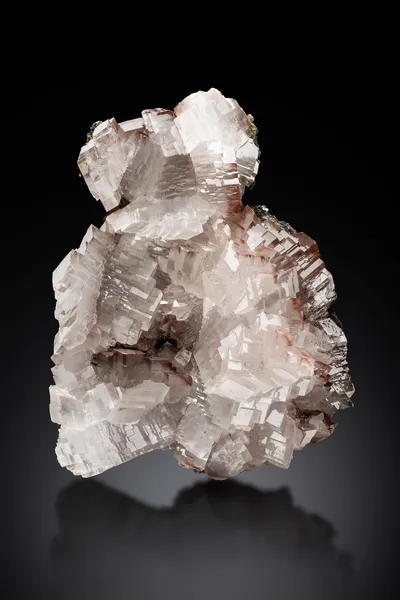
Fluorite is a very rare mineral in the Tsumeb deposit and can be considered extremely rare in specimen quality. Many fluorites attributed to Tsumeb are from other Namibian localities.
Fluorite appears to have been first reported at Tsumeb in 1973 (unpublished TCL report; cited by Bartelke 1976). Bartelke described the fluorite as bluish and "rarely detected" under the ore microscope.
Pinch and Wilson (1977) reiterated the Bartelke (1976) notes referring to "…minute bluish inclusions [of fluorite] visible only under the microscope". However, they also noted that "… two excellent specimens each with crystals over 1 cm have recently been located." These are almost certainly not from Tsumeb, but their descriptions are consistent with material from the Okorusu fluorite mine, some 120 km southwest of Tsumeb.
Lombaard et al. (1986) noted that: "Limited amounts of non-metallic hypogene gangue minerals are present, principally calcite, quartz and dolomite and rarely barite and fluorite." They list fluorite as a "rare" species.
Gebhard (1999) described fluorite as "extremely rare". He noted the discovery of colourless 2 mm crystals associated with calcite in the third oxidation zone just before the mine closed in 1996 and considered this to be the first find that was unequivocally from Tsumeb.
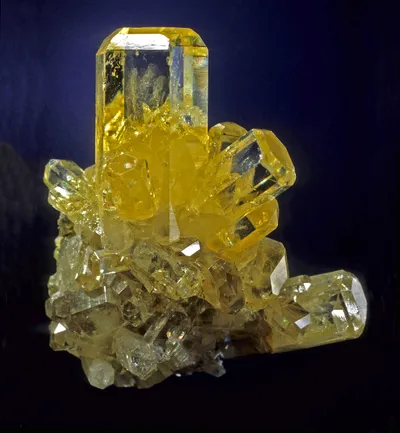
A specimen in the Pinch Collection at Harvard University (MGMH 2020.7.1929) comprises a single (8 mm) crystal of yellow-green fluorite, accompanied by a few colourless quartz points and a white unidentified carbonate mineral, probably calcite, in a vuggy sulphide matrix. The specimen was originally in the Uli Bahmann Collection and is attributed to Tsumeb; further analysis is desirable to establish its Tsumeb provenance.
Associated Minerals
calcite; mimetite; quartz